Personalized Online Cards That Feel Like You
Personalized online cards make it easier to show up with care. Learn how to create a thoughtful, private card that feels personal, not rushed at all.
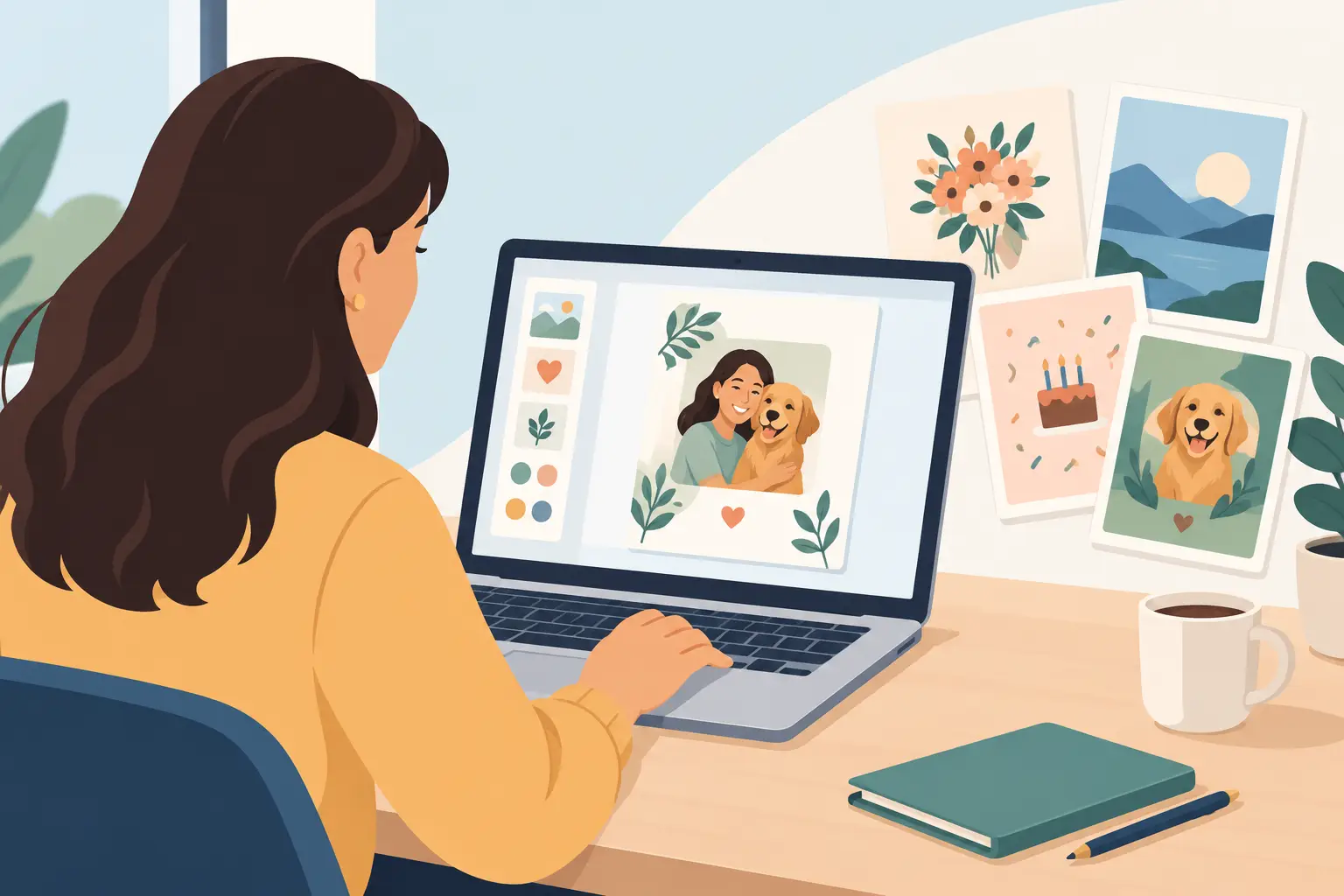
A good message rarely arrives at a convenient time. It comes when a friend is starting over, when your partner needs reassurance, when a coworker deserves real thanks, or when you remember a birthday halfway through the day. Personalized online cards give that feeling somewhere more considered to land than a quick text.
They are not meant to replace every handwritten note. A card in the mail still has its own quiet charm. But when distance, timing, or everyday life gets in the way, a beautifully made digital card can turn a small intention into a moment someone pauses to keep.
Why a personal card still matters
We send plenty of messages that are useful: “Made it home,” “Can you call me?” “Happy birthday!” They keep life moving. The messages people return to, though, usually do something else. They make a person feel seen.
A card creates a little space around your words. It says this was not sent between meetings or while standing in line for coffee. Even if it took only a few minutes to make, it carries a different kind of attention.
That is especially meaningful when you cannot be there in person. A thoughtful note can cross time zones, soften a difficult week, or mark a milestone without asking the recipient to perform a big response. They can open it when they have a quiet moment. They can read it again later.
The difference is not elaborate writing. It is specificity. Instead of “Thinking of you,” try: “I saw the first cold morning of the year and thought of the walk we took when you convinced me to get hot chocolate.” The detail is small. The feeling is not.
What makes personalized online cards feel personal
Personalization is more than putting someone’s name at the top. It is the meeting point of your words, the visual mood, and the way the card is shared. A minimal botanical design might suit a thank-you to a mentor. A soft watercolor card can hold an encouragement message without making it feel overly serious. A darker, more editorial style may be right for a romantic note that calls for fewer, better-chosen words.
The best design does not compete with the message. It gives the message a setting.
This is where generic e-cards can fall short. A loud animation, a stock joke, or too many decorative choices can make a sincere note feel like a template wearing someone else’s personality. There is nothing wrong with playful cards when the relationship calls for them. But for a meaningful occasion, restraint often leaves more room for the recipient.
A personal online card should also feel private. Some messages are meant for a public feed. Others belong to one person. Sharing by a private link or WhatsApp lets the gesture arrive directly, without turning an intimate moment into an announcement.
Start with the occasion, then choose the feeling
Before choosing a design, ask a simpler question: what do you want this person to feel when they open it?
For gratitude, the feeling may be recognition. For a birthday, it may be delight and familiarity. For someone going through a hard time, it may be companionship without pressure. For romance, it may be closeness. This question gives you a better direction than trying to find the “perfect” card.
A thank-you card, for example, becomes warmer when it names what the person did and what it changed for you. “Thank you for checking in when I was overwhelmed” feels more lasting than “Thanks for everything.”
For a new job, move, graduation, or fresh start, avoid the urge to turn your message into advice. A few clear lines of belief can be enough: “You have worked toward this for a long time. I hope you take a moment to let yourself feel proud.”
For a thinking-of-you note, keep the expectation low. The point is not to solve anything or require an answer. “No need to reply. I just wanted you to know you crossed my mind today” can be a generous message precisely because it asks for nothing back.
Write words that sound like you
Many people hesitate because they think a card needs to be poetic. It does not. The most memorable message often sounds like a voice the recipient already knows.
Start with the truth of the moment. Then add one detail, memory, or observation that could only belong to the two of you. End simply. This can be as brief as three sentences.
For a friend: “I still laugh when I think about our rain-soaked dinner in Portland. You have a way of making even the slightly chaotic days feel lighter. I’m very glad you’re in my life.”
For a partner: “I love the ordinary parts of being with you - the grocery lists, the late-night kitchen talks, the way you always remember my coffee. Thank you for making home feel like a person.”
For a coworker: “Your calm made a difficult project feel manageable. I noticed the care you brought to every detail, and I’m grateful to have worked alongside you.”
You do not need to imitate these words. In fact, you should not. Let them remind you that sincerity is usually concrete, not complicated.
If you are stuck, write the message as if you were leaving a voice note. Then remove the extra explanation. Keep the sentence that sounds most like you.
A few details go further than a long letter
Length depends on the relationship and the occasion. A birthday card from across the country may hold a longer memory. A midweek encouragement card may need only two lines. Both can matter.
What matters more is whether the card has a center. Choose one idea: appreciation, celebration, reassurance, apology, anticipation. Trying to say every feeling at once can make the message less clear. One honest thought, well expressed, has room to stay with someone.
Use photos and music with intention
Premium digital cards can add another layer of memory. A few photos can turn a birthday greeting into a small record of a friendship. A song can set the emotional temperature before the recipient reads a word. Downloadable keepsake files give them something they can save beyond the moment it was sent.
More is not always more, though. Six photos work beautifully when they tell a small story: a trip, a year together, a family milestone. For a quiet apology or a tender thinking-of-you message, one strong image or no image at all may feel more fitting.
The same is true of music. Choose a song because it means something, not because it fills a feature. Perhaps it was playing on a first date, belongs to a road trip, or simply says what feels difficult to write. If the recipient is likely to open the card in public, remember that music can be unexpected. The card should still feel complete in silence.
Make sharing part of the care
Delivery changes the experience. A link sent with “Open this when you have a minute” creates anticipation without pressure. A WhatsApp message can feel natural for someone you speak with there every day. If the card contains a more private message, optional PIN protection offers an extra layer of consideration.
Timing is worth thinking about, but do not let it stop you. Sending a birthday card at 9 p.m. is better than waiting until next year. Sending an encouragement card on an ordinary Tuesday can be more meaningful than sending one only when an occasion tells you to.
For planned moments, create the card before the day gets busy and write the delivery message separately. Keep it light: “I made you a little something.” Let the card carry the fuller feeling.
Choose convenience without making it feel convenient
The appeal of digital stationery is not that it saves effort at all costs. It is that it removes the unhelpful friction between feeling something and expressing it. You do not need to find a store, choose a stamp, or wonder whether the mail will arrive in time.
At WishRise, free cards can be made and shared without creating an account. When a moment calls for more, a CHF 1.99 Premium card can include up to six photos, a song, downloadable keepsakes, and optional PIN protection. There is no subscription waiting behind the gesture.
That simplicity matters because care is often spontaneous. You remember. You make something lovely. You send it.
A personalized card will not fix distance, erase a hard season, or say everything a relationship holds. It can do something quieter: remind someone that, amid the noise of the day, they mattered enough for you to pause and choose your words.